How to control who gets alerted and when it escalates
First responder, owner fallback, quiet hours and noise control.
Incident routing decides who an incident reaches, in what order, and how long before it climbs. There is no escalation ladder to maintain — who gets alerted follows from who is on the workspace.
Who can do this: Owner and DevOps. Everyone can read it.
Check what happens tonight
Open Incident routing. The card at the top states the whole policy in one sentence, recomputed from your actual team.

If it does not say what you expect, something below needs changing. That sentence is the test.
Who gets alerted
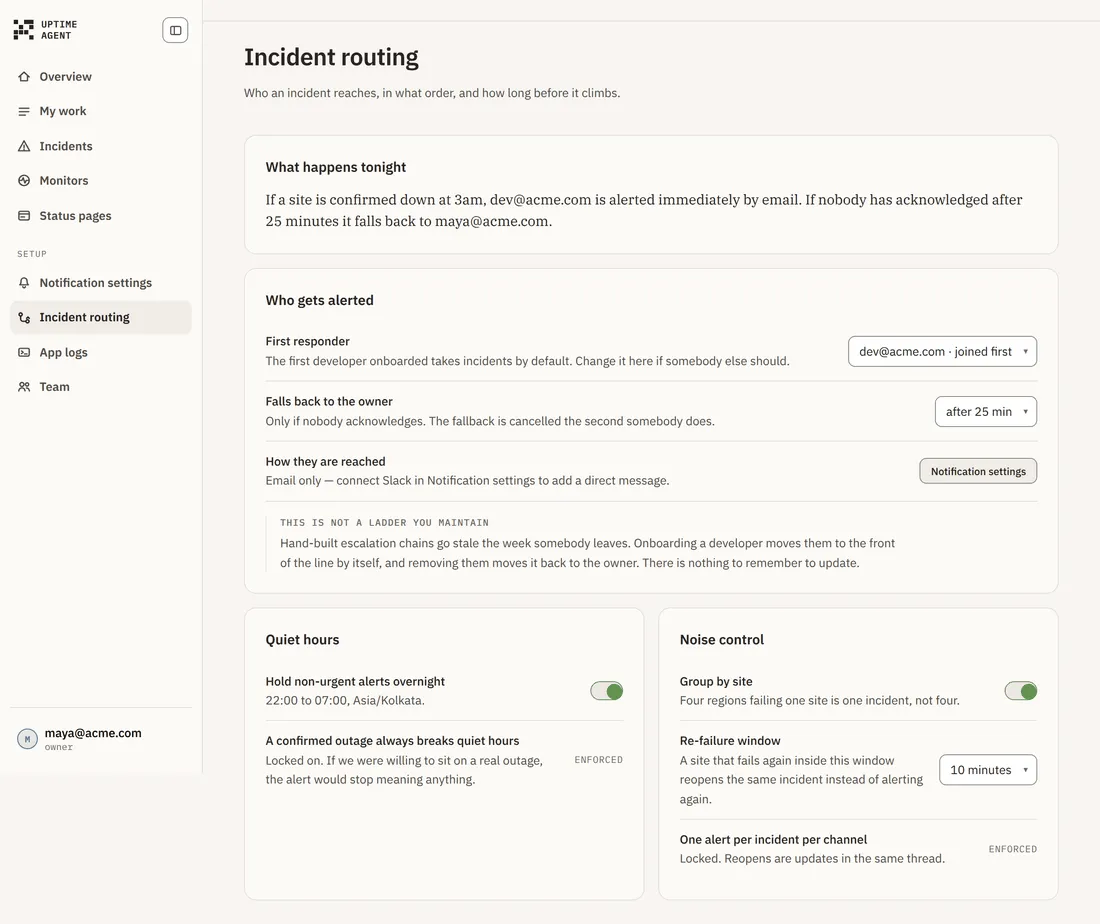
- First responder — the first developer onboarded takes incidents by default. With two or more, a dropdown lets you choose someone else. With no developer at all, every incident is assigned to you the moment it is confirmed.
- Falls back to the owner — only if nobody acknowledges. Choose after 10, 15, 25 or 45 minutes. The fallback is cancelled the second somebody acknowledges.
- How they are reached — email, plus a Slack direct message if Slack is connected. Acknowledge and resolve are buttons inside the message.
Why there is no ladder
Hand-built escalation chains go stale the week somebody leaves. Onboarding a developer moves them to the front of the line by itself, and removing them moves it back to the owner. There is nothing to remember to update.
If you have no developer yet, an invite field appears directly on this page. The moment they accept, incidents route to them instead of you.
Quiet hours
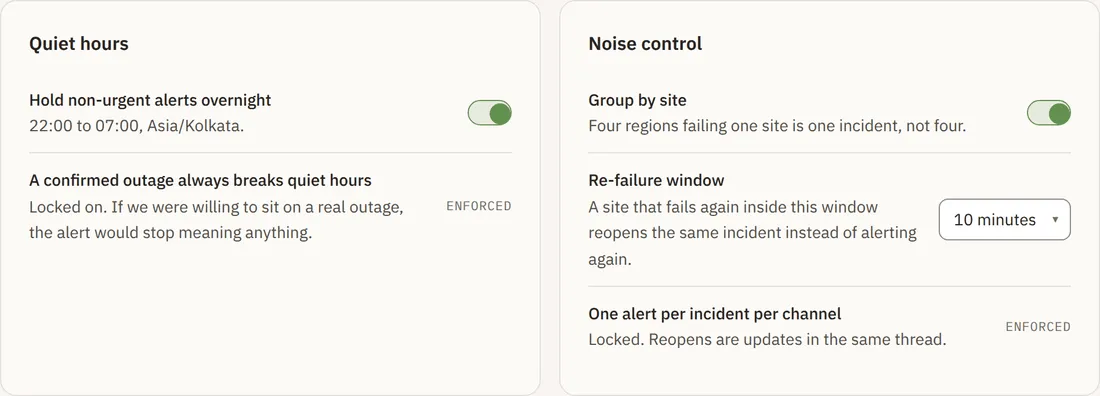
Hold non-urgent alerts overnight — the window and time zone are shown on the card.
A confirmed outage always breaks quiet hours. That is enforced and cannot be switched off: if we were willing to sit on a real outage, the alert would stop meaning anything.
Noise control
- Group by site — four regions failing one site is one incident, not four.
- Re-failure window — 10 minutes, 30 minutes or 1 hour. A site that fails again inside this window reopens the same incident instead of alerting again.
- One alert per incident per channel — locked. Reopens are updates in the same thread.
Troubleshooting
Alerts are still going to me, not my developer. Check the invite has been accepted. Routing changes when they accept, not when you send it.
Nobody was alerted overnight. If the signal was slowness rather than a confirmed outage, quiet hours held it. Confirmed outages are never held.
The owner got paged even though someone was working on it. The fallback fires when nobody has acknowledged. Working on an incident without acknowledging it does not stop the timer.